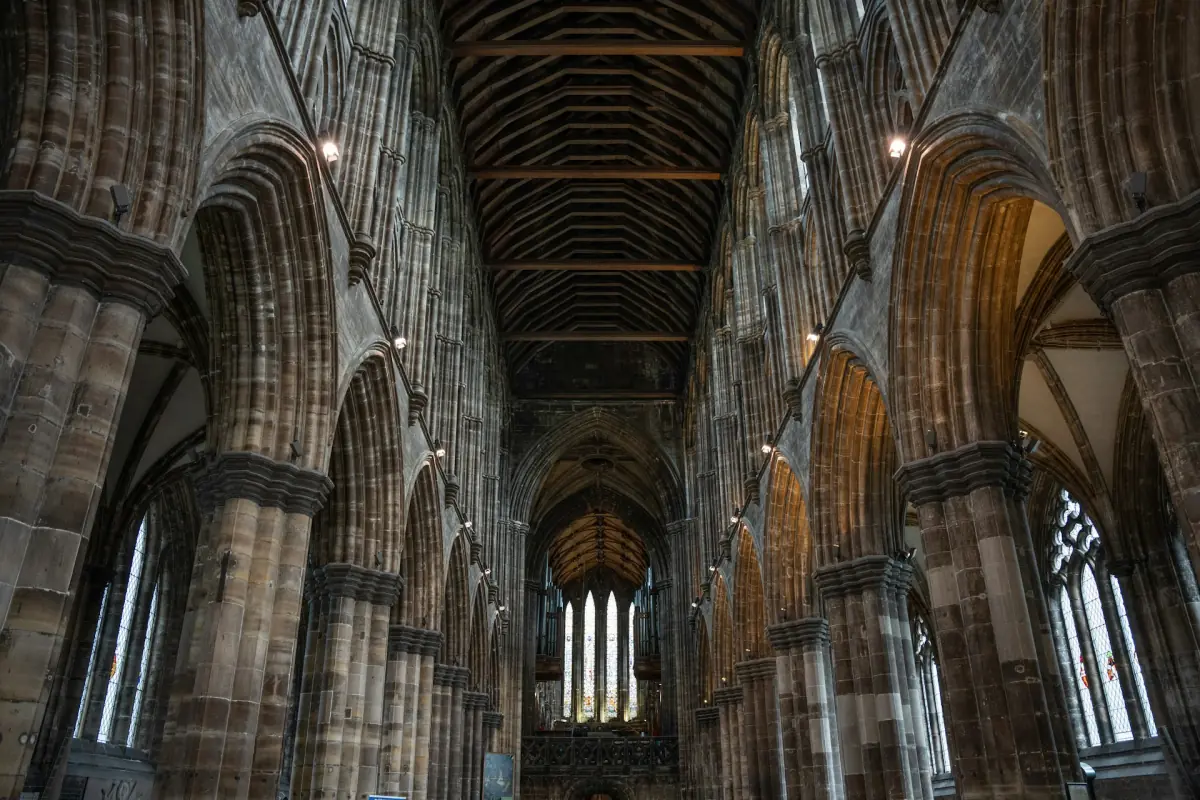
Glasgow Cathedral history and the story of St Mungo
Glasgow Cathedral history centres on St Mungo, also known as St Kentigern. He is thought to have been the first bishop of what is now Strathclyde. Tradition places his burial here around 612. The link between the saint and the site explains why the medieval church made room for a shrine beneath the main level.
Kentigern and Mungo are two names for the same person. The burial tradition provides the starting point for the story of the site, while the stone building you can see belongs largely to a later period. Keep those layers in mind when moving from the nave down to the lower church.

St Mungo’s tomb and the medieval pilgrimage site
Glasgow Cathedral’s lower church was built in the 13th century for St Mungo’s tomb, whose shrine drew medieval pilgrims. Stone columns support the space. The descent changes the way the building reads. In the nave, the scale and pointed arches stand out, while in the lower church the columns and shrine give the visit a different focus.
The lower church is reached by 25 steps with a handrail. If the shrine is the part you most want to see, use the cathedral’s visitor hours and access information to allow time for the descent and to plan your own visit inside.
A walk through Glasgow
This guided city walk includes the cathedral and local stories.
Hand-picked tours, booked through GetYourGuide. Prices are indicative starting prices in British pounds (as of November 2026). Tap a tour for live availability and the current price in your currency.

Glasgow’s history on a city walk
Hear stories from a local guide on a city route that takes in Glasgow Cathedral and the Necropolis.
A city walk through the cathedral quarter
The Glasgow city highlights walk lasts 1.5 hours, starts at 82 George Square and includes a local guide and stories about the city. Glasgow Cathedral and Glasgow Necropolis are on the route. For a look inside the cathedral, set aside time during public visiting hours. The guide to tours around the cathedral covers other ways to explore the area with a guide.
From Romanesque predecessor to Gothic cathedral
Most of Glasgow Cathedral’s present building dates from the 13th century and follows an earlier Romanesque cathedral. Expansion began under Bishop Jocelin in 1181. After a fire, work continued, particularly under William de Bondington, who was bishop from 1233 to 1258. Look for Gothic pointed arches, tracery and vaulted aisles as you move through the building.
The stone pulpitum between nave and choir dates from the early 15th century. Use the screen to pick out the division between the two spaces. Look up for another layer of the interior in the stained glass, which includes post-war windows. The screen and glass give you two features from different periods to look for on the same visit.
The Reformation, three congregations and worship today
Glasgow Cathedral is a Church of Scotland place of worship and a Historic Environment Scotland site. Furnishings were removed during the Reformation, and at one point three congregations used different parts of the building. The Outer High Kirk and Barony Kirk had moved out by 1835. The building passed into state ownership in 1836, with state management of the entire building from 1857.
Sunday worship begins at 11:00, with sightseeing normally beginning at 13:00. For a different period of local history, cross into Glasgow Necropolis to explore the cemetery and its early burials.
Questions about Glasgow Cathedral’s history
Glasgow Cathedral brings together a medieval pilgrimage site, Gothic architecture and a congregation that still worships in the building.
When was Glasgow Cathedral built?
The 13th century accounts for most of Glasgow Cathedral’s standing fabric. A Romanesque cathedral preceded it, and expansion began under Bishop Jocelin in 1181. When looking inside, the early 15th-century stone screen and the post-war stained glass help distinguish the medieval building from later additions.
Are St Mungo and St Kentigern the same person?
Yes, St Mungo and St Kentigern are two names for the same saint. Tradition places his burial at the cathedral site around 612. The medieval shrine became a place of pilgrimage, and the 13th-century lower church was built to house his tomb.
Is Glasgow Cathedral still a place of worship?
Yes, Glasgow Cathedral is an active Church of Scotland church as well as a Historic Environment Scotland site. Sunday worship begins at 11:00. If you are visiting for the building and its history, normal Sunday sightseeing begins at 13:00. Allow for dated changes to visiting hours.